

Solitaire - Puzzle Images
MTAG PUBLISHING LTD
I found Solitaire - Puzzle Images most appealing in the kind of quiet household moment when one person is waiting for dinner, another is watching television, and a phone is passed around without anyone wanting a complicated multiplayer game. It is a card game built around solitaire puzzles and picture-based progress, so the basic attraction is easy to understand: play a familiar solo card format, make matches, and gradually complete images. I could start a round without learning a long rulebook, which makes it suitable for short breaks and casual shared-device use.
My overall impression is that it works best as a light, visual solitaire experience rather than as a deep strategy title. The completed pictures give the familiar card routine a small sense of purpose, while the free entry point makes it easy to try. At the same time, the modest average rating of 3.7 from around 500 ratings suggests that the experience will not satisfy everyone equally. I would treat it as a pleasant option for occasional play, not an automatic replacement for every classic solitaire app.
How the picture-based solitaire loop feels in everyday use
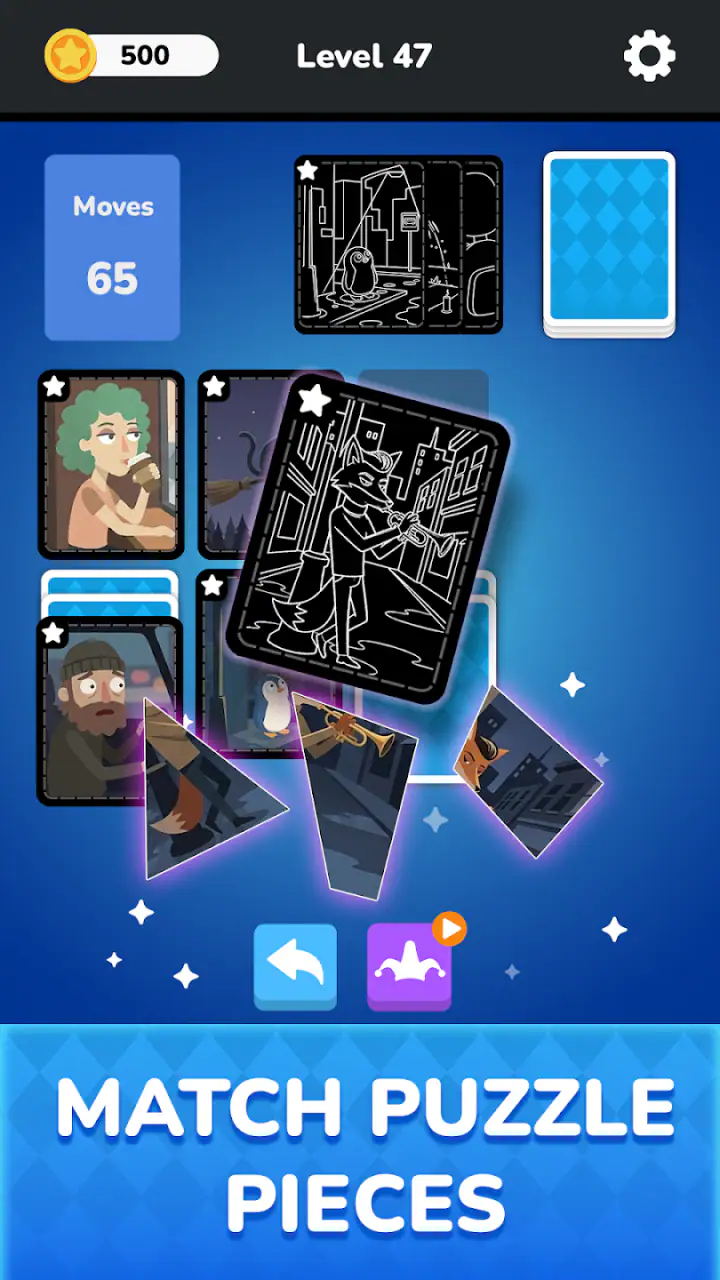
The central loop is deliberately straightforward. I deal with the card puzzle, look for useful moves, and work toward matching or arranging cards while the image collection provides a visual reason to continue. That structure is familiar enough for someone who already plays solitaire, but the picture element gives the session a more noticeable sense of progress than a game that simply ends with a win or loss.
That makes it a good fit for an ordinary waiting-room visit or a short commute when I am not in the mood for a demanding game. I can focus on one puzzle, put the phone down, and return later without needing to remember a complicated story. For a household, this also matters: a family member can understand the objective quickly, even if they do not usually play mobile card games.
The image focus changes how I judge a round. In a traditional solitaire app, the satisfaction usually comes from clearing the layout efficiently. Here, I also pay attention to the gradual completion of the picture. That visual reward may be especially useful for players who find endless card deals repetitive. It gives the session a collection-like direction without requiring a large commitment from the player.
Related News






A practical way to share one device
On a shared phone or tablet, I would use the game in turns rather than treating it as a competitive family activity. One person can begin a puzzle, another can suggest a possible move, and the owner can decide whether to follow it. This works because solitaire is naturally turn-based in spirit, even though the game is designed for one player.
There is a useful trade-off here. Sharing a puzzle can make the picture goal feel like a small household project, but it can also remove the calm, private quality that makes solitaire attractive. I would avoid handing the device to a young child while a player is in the middle of a carefully planned layout. A better routine is to finish a round, then let the next person start a fresh one.
For a parent, partner, or roommate, the game can therefore serve as a low-pressure conversation starter rather than a true shared game. Someone can ask which image is being completed or point out a card opportunity, but there is no reason to expect synchronized progress between different people. If you want a game built around direct cooperation, this is not the right category; its strength is the ability to share the moment without requiring everyone to play at once.
Gallery
Keeping expectations clear on a household device
Because this is a solo card game, I would establish a simple boundary before installing it on a device used by several people: decide who is responsible for progress and purchases. The game is free to download, but it includes optional in-app items ranging from $0.99 to $99.99 each. That is the most important practical point for a shared phone or tablet.
I would not leave a child or guest to explore purchase prompts casually on an unlocked device. Even when the game itself is easy to understand, a player may interpret a helpful-looking option as part of the normal route through a puzzle. A household rule such as “play freely, ask before buying” is more useful than assuming everyone will make the same decision.
This also affects how I would evaluate the game for older relatives. Someone who enjoys solitaire but is uncomfortable with mobile purchasing may prefer to play only when the device owner is nearby. The card mechanics are accessible, but comfort with the surrounding phone experience still matters. In my view, the game is easiest to recommend when the person using it understands that free access and optional spending are separate things.
Another boundary is time. Picture completion can encourage “just one more” rounds, especially when a player is close to finishing an image. In a family setting, I would avoid presenting it as a reward that must be earned repeatedly. It is better used as a short leisure activity, with the player free to stop after a puzzle rather than feeling pushed to continue collecting.
What makes it different from plain solitaire
The image system is the clearest distinction from a bare-bones solitaire application. A standard version can be ideal when I want nothing but cards, quick restarts, and a familiar layout. This game adds a visual destination, which may help when the usual win screen no longer feels rewarding.
That extra layer is not automatically better. Players who prefer a clean, distraction-free card table may find the picture goal unnecessary. If your priority is the most traditional solitaire experience, a simpler alternative may feel more focused. If you like a visible collection objective and want the card game to feel slightly more like a puzzle journey, this version has a stronger reason to return.
It also differs from competitive card games. There is no need for me to match another player’s speed, understand a changing opponent, or coordinate a group session. That makes it more forgiving for a mixed-age household, but it also means there is less social energy. I would choose it for quiet concentration, not for a family game night where everyone expects direct interaction.
Compared with elaborate puzzle games, the appeal is similarly restrained. The card rules are easier to pick up, and the image objective gives the experience some variety without asking me to master a new control system. The downside is that players who want complex levels, dramatic challenges, or a strong narrative may find the loop too gentle.
Age context and trust when children use it
The content rating is Everyone, which fits the non-violent, card-based nature of the experience. I would still separate content suitability from spending suitability. A game can be appropriate for a child to see and play while its optional purchase path remains something an adult should supervise.
For younger children, the picture goal may be easier to understand than a purely abstract solitaire score. They can see that cards are being used to work toward a completed image. However, I would not assume that visual rewards make the game educational or that every child will understand the strategy without help. It is best described as casual entertainment with simple card decisions.
For older children and teenagers, the main question is whether they enjoy patient, individual play. The game does not appear suited to someone looking for fast action or a social challenge. It may work well during a quiet break, but it is unlikely to compete with multiplayer games when the child wants interaction with friends.
Trust also matters between adults. If several people use the same device, progress can become confusing if one person changes the current puzzle or spends money without discussing it. I would recommend keeping the game associated with the device owner’s routine and treating any completed images as shared entertainment only if everyone agrees. That simple arrangement prevents a casual card game from becoming a source of household friction.
Device fit, access, and version expectations
The game supports devices running Android 7.1 or later, so it can be considered for many older Android phones and tablets rather than only recent hardware. That is useful for a household that keeps an older device for casual use. Still, compatibility on paper does not guarantee that every older device will feel equally comfortable, especially when a larger screen would make card placement and image details easier to see.
The current version is 0.5, which makes me approach it as an experience that may still be developing. I would be patient with small rough edges and avoid expecting the polish of a long-established solitaire standard. For a shared household device, this also means checking how the game behaves after installation and deciding whether it feels stable enough for the person who will use it most.
The developer is MTAG PUBLISHING LTD, and the game has passed the 100K-install mark. That gives it a meaningful existing audience, but I would not use popularity alone as proof that it matches your preferences. The rating and the relatively limited review volume point toward a product with a mixed reception, so trying it yourself is more sensible than relying on the install figure.
Since it is free to start, the lowest-risk approach is to install it on the intended device, play several ordinary rounds, and observe whether the picture progression actually adds enjoyment. I would do this before allowing regular shared use. If the card loop feels repetitive after a few sessions, the image collection may not be enough to change that judgment.
Small strategies that improve a shared play routine
My first practical tip is to let one person finish a puzzle before passing the device on. Solitaire depends on remembering which cards have been exposed and which moves were deliberately postponed. Interrupting halfway through can turn a relaxing session into confusion, particularly when another household member does not know the original plan.
Second, use the picture objective as a stopping point. Instead of asking a player to stop at an arbitrary time, agree that a completed image or a natural end to the current deal is the handover moment. This keeps the household routine predictable and avoids the common problem of someone taking the phone just as a player reaches an important decision.
Third, keep purchases outside the shared play ritual. Because the available items can reach $99.99, I would never treat an in-game offer as a casual group decision made by whoever is holding the device. If someone wants an optional item, the device owner should review it separately. This is especially important when children, visitors, or relatives who are unfamiliar with mobile games are involved.
Fourth, use the game as a quiet alternative rather than a universal family activity. A household can enjoy discussing the pictures or taking turns, but not everyone will want to participate. Giving people permission to play alone preserves the main reason solitaire works: it does not demand coordination, conversation, or a shared schedule.
Who should choose it, and who should skip it
I would recommend it to someone who already likes solitaire but wants a little more visual motivation. It is also a reasonable choice for a person who prefers short, self-contained sessions and does not want the pressure of opponents or timed competition. The picture-completion angle gives casual players something to work toward without making the basic card activity difficult to understand.
It can suit a household with one shared Android device when the adults agree on progress and spending boundaries. The Everyone rating makes it approachable across age groups, while the solo format means nobody has to create an account-based team or arrange a simultaneous session simply to play. That convenience is its strongest household quality.
I would skip it if you want a completely traditional solitaire table with no collection-oriented layer. I would also look elsewhere if you need robust social play, competitive rankings, or a game designed specifically for several people on one screen. Likewise, anyone who dislikes optional purchase prompts should be cautious about installing it on a child-accessible device, even though the game itself is free to begin.
Players seeking deep strategic variety may also outgrow it. The visual objective adds motivation, but it does not turn a casual solitaire format into a complex strategy game. In my experience, its value depends on whether you enjoy the rhythm of card decisions and find picture progress satisfying. If neither part appeals to you, the game has little else to carry the experience.
My household verdict
Solitaire - Puzzle Images is a modest, approachable card game that makes the familiar solitaire routine more visually purposeful. I like it most as a personal wind-down game that can also be passed around casually after a round is complete. The picture goal is a useful twist, particularly for players who need more motivation than a simple win message provides.
Its household strengths are clear: the Everyone rating, the free starting price, the accessible card format, and the fact that it does not require direct competition. Its limitations are just as important: optional purchases need adult attention, shared progress can become muddled, and the solo format should not be mistaken for genuine multiplayer entertainment. The current version, 0.5, also encourages realistic expectations about polish and ongoing refinement.
My final advice is simple. Try it on the device that will actually be used, let each person learn the card loop without pressure, and agree in advance that purchases require the owner’s approval. If the completed images make ordinary solitaire feel fresh, this game can earn a comfortable place in a quiet household routine. If you want richer strategy, stronger social interaction, or a completely minimal card table, a different solitaire or card game will be a better fit.
FAQs for Solitaire - Puzzle Images
What is Solitaire - Puzzle Images?
Solitaire - Puzzle Images is a casual card game that combines classic solitaire gameplay with image-based puzzle progression. You play familiar solitaire rounds, usually by arranging cards in ascending and descending sequences, and use your progress to unlock or complete pictures. It is designed for relaxed, short sessions and may appeal to players who enjoy both traditional card games and simple visual rewards.
How does the gameplay work in Solitaire - Puzzle Images?
The main gameplay follows the basic principles of solitaire: organize cards by alternating colors and place them in the correct order while revealing hidden cards. Depending on the level, you may receive objectives, hints, or limited moves that affect your strategy. Completing rounds helps you advance through image puzzles, so careful planning is often more useful than making moves quickly.
Can Solitaire - Puzzle Images be played offline?
Many solitaire games allow the core card rounds to be played without a constant internet connection, but offline availability can depend on the version, device, and specific feature being used. Basic gameplay may work offline after installation, while advertisements, cloud synchronization, updates, rewards, or certain image content may require internet access. Check the app listing and test the game before relying on it offline.
Is Solitaire - Puzzle Images free to download and play?
Solitaire - Puzzle Images is generally presented as a free-to-download game, allowing users to try the main solitaire experience without an upfront purchase. However, free games commonly include advertising, optional in-app purchases, or paid items such as extra hints, boosters, lives, or ad removal. Review the store’s pricing information and your device’s purchase settings before downloading.
Is Solitaire - Puzzle Images suitable for beginners?
Yes, the game should be approachable for beginners because solitaire rules are relatively easy to learn and most players can understand the basic card movements after a few rounds. The image-puzzle structure also provides an additional goal beyond simply winning. New players should use hints carefully, learn which cards to reveal first, and avoid spending optional resources until they understand the level system.
Pros
- Relaxing solitaire gameplay suitable for short or extended sessions.
- Puzzle images add variety beyond standard card challenges.
- Simple controls make it accessible for casual players.
- Offline play is convenient when no internet connection is available.
- Progression and completed images provide a satisfying sense of achievement.
Cons
- Some puzzles may become repetitive after extended play.
- Difficulty balance can vary between different image challenges.
- Ads may interrupt gameplay
- especially between completed rounds.
- Limited customization may disappoint players seeking more card themes.
- Progress can feel slow if hints or extra features require rewards.


